
When It’s Time to Replace an Air Conditioner Instead of Repairing It
Most homeowners don’t wake up one day and decide to replace their air conditioner — it’s usually a decision that gets made for them, one repair bill at a time. If a technician has been out twice in the same summer, if the unit is pushing fifteen years old, or if it’s running constantly without actually getting the house comfortable, you’re past the point where another repair makes financial sense. We do honest air conditioner repair work in Eudora and Lawrence, and we’ll always tell you when a repair is the right call — but there’s a point where a repair just delays a replacement you’re going to need in a year anyway, and it’s worth knowing where that line is before you’re standing in a hot living room deciding under pressure.
A rough rule of thumb: if the repair estimate is more than a third of what a new system would cost, or the refrigerant type your unit uses has been phased out, replacement is usually the better math. Age matters too — a well-maintained system can run fifteen to twenty years, but efficiency drops well before it fails outright, so a unit that’s merely “still working” can still be costing you real money every month on the electric bill.
What Actually Drives the Cost of a New AC in an Eudora Home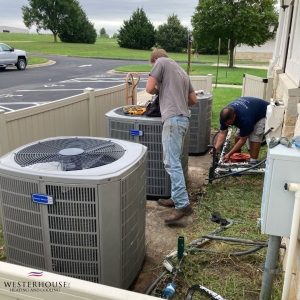
The number that ends up on your invoice depends on more than the size of the unit. Older Eudora homes — a lot of the housing stock here predates modern HVAC design — sometimes need ductwork modifications to work well with a new high-efficiency system, and that’s a real cost variable a lot of quotes gloss over. Newer construction out toward DeSoto tends to be more straightforward since the ductwork was designed for modern equipment from the start, but even there, correct sizing still matters more than most homeowners expect.
SEER rating (how efficient the unit is) is the other big lever. A higher-SEER unit costs more upfront and less every summer after that — where that trade-off breaks even depends on how long you plan to stay in the house and what the local electric rates look like. We install American Standard systems, and being an authorized dealer means we’re not guessing at compatibility or warranty terms — the manufacturer backs the install, not just the parts.
Sizing Mistakes cost the homeowner
We see more sizing mistakes than almost any other installation shortcut, mostly because it’s invisible on a quote — nobody can tell from a price sheet whether a contractor ran an actual load calculation or just matched the tonnage off the old unit’s nameplate. An oversized system is the one that fools people: it cools the house fast, so the first week feels great, but it’s short-cycling every few minutes instead of running a longer, steadier cycle, and that’s harder on the compressor and pulls a lot less humidity out of the air over the course of a summer. Undersized units are more obvious — they just never quite catch up once it’s over 95 outside, and we usually get that call within the first season.
Getting it right means going through square footage, insulation, how many windows face west, and what kind of shape the ductwork is in, not just reading a number off the old equipment. It takes longer to quote a job that way, which is part of why one $5,000 install ends up performing like it cost $7,000 and another one never quite keeps up.
What Installation Day Looks Like
Most jobs in an existing Eudora home wrap up in a single day — we’re usually on-site by 8, and the new system’s running by mid-to-late afternoon, assuming the ductwork doesn’t need rework. When it does, it’s often because the ducts were built around a furnace from thirty years ago and don’t quite match what a modern system expects, and that can push things into a second day. The crew pulls the old indoor and outdoor units, sets the new equipment, and runs fresh refrigerant lines if the existing ones aren’t rated for the new system’s charge.
Before anyone packs up, we run the air conditioner installation under load for twenty or thirty minutes, checking the temperature split at the supply vents and watching how the pressures hold once the compressor’s been cycling for a while — that’s what catches a slow leak or a wiring issue in your driveway, instead of during the first heat wave in July when nobody wants to wait three days for a service call. If the job needs a permit through the city or Douglas County, or if there’s electrical panel work involved, we’re the ones scheduling that.
Before the crew leaves, you should walk away knowing how to work the thermostat, what the warranty actually covers, and when the first maintenance visit should happen. If nobody offers to explain any of that, that’s worth asking about before you sign off on the job — a rushed handoff is often a sign of a rushed installation.
Financing and What the Warranty Actually Covers
A full system replacement is a real expense, and we offer financing through a third-party provider for homeowners who’d rather spread the cost out than pay it in one shot. American Standard’s manufacturer warranty covers parts for a defined term when the system is registered properly after installation — registration is something we handle at the time of installation, not something we leave for you to remember to do six months later.
Worth asking any installer directly: does the warranty cover labor, or only parts? A lot of quotes look similar on price until that question gets answered, and it’s usually where the real difference between a $4,000 quote and a $6,000 quote actually lives.
Why Eudora and Lawrence Homeowners Tend to Choose a Local Installer
A national chain can usually match us on equipment — American Standard sells the same units to everybody. What’s harder to match is a technician who isn’t going to sell you something you don’t need because he has a monthly quota. We’re a family business headquartered right here at 104 W 20th St., not a regional franchise dispatching whoever’s available, and if something needs a warranty call in year six, we’re still going to be the ones answering the phone.
If you’re weighing quotes right now, our air conditioner installation page has more details, or you can just call us directly at (785) 542-2707, and we’ll talk through what your specific house actually needs before you commit to anything.